





Equipment
E.A.R.L.
One of the most important members of the Equipment Specifications and Certifications team at the United States Bowling Congress isn't a scientist, it's a state-of-the-art ball-throwing robot named E.A.R.L.
E.A.R.L. (Enhanced Automated Robotic Launcher) is designed to be able to consistently simulate any type of bowling style with an accuracy and consistency on the lanes that no human bowler can achieve. Those qualities make E.A.R.L. invaluable in the many studies necessary to keep up with the ever-changing bowling ball industry.
The newest member of the team, E.A.R.L. has been brought in to replace the organization's first robot, Harry, which was introduced in 1999 and recently was retired after more than a decade of research.
Harry was a unique, computer-controlled hybrid machine partly encased in safety glass that combined hydraulics, air pressure and electronics to power a mechanical arm that delivered bowling balls to help test balls, lanes, pins and oil patterns. Harry was similar to the United States Golf Association's robotic golfer "Iron Byron," whose mechanical arm swings golf clubs for research purposes.
E.A.R.L. has more automated features than Harry and can throw the ball left-handed or right-handed. It can consistently duplicate shot after shot at ball speeds anywhere from 10-24 miles per hour and rev rates anywhere from 50-900 rpm, a significantly wider range than its predecessor.
Pairing the robot and the International Training and Research Center's computerize ball-tracking program, a computer and sensor system that precisely tracks bowling ball location and speed as it travels down a lane, gives USBC a key advantage in the sophisticated tracking and measurement of ball motion data.
The main goal of the ball motion studies, started in 2005, is to gather data about the complex dynamics and inner motion characteristics of today's high-tech bowling balls. USBC is testing to determine how balls with different properties and characteristics act together, then use this and other information obtained in working with bowling ball manufacturers and other industry leaders to set performance-based specifications for bowling balls used in USBC-certified competition.
E.A.R.L. was named by USBC Junior Gold youth bowler Melissa Stewart of Roswell, Ga. She figured if bowling great Earl Anthony's nickname was "The Machine," then it was only "fitting to name the new ball-throwing robot for a bowler with machine-like characteristics."
Bowlscore
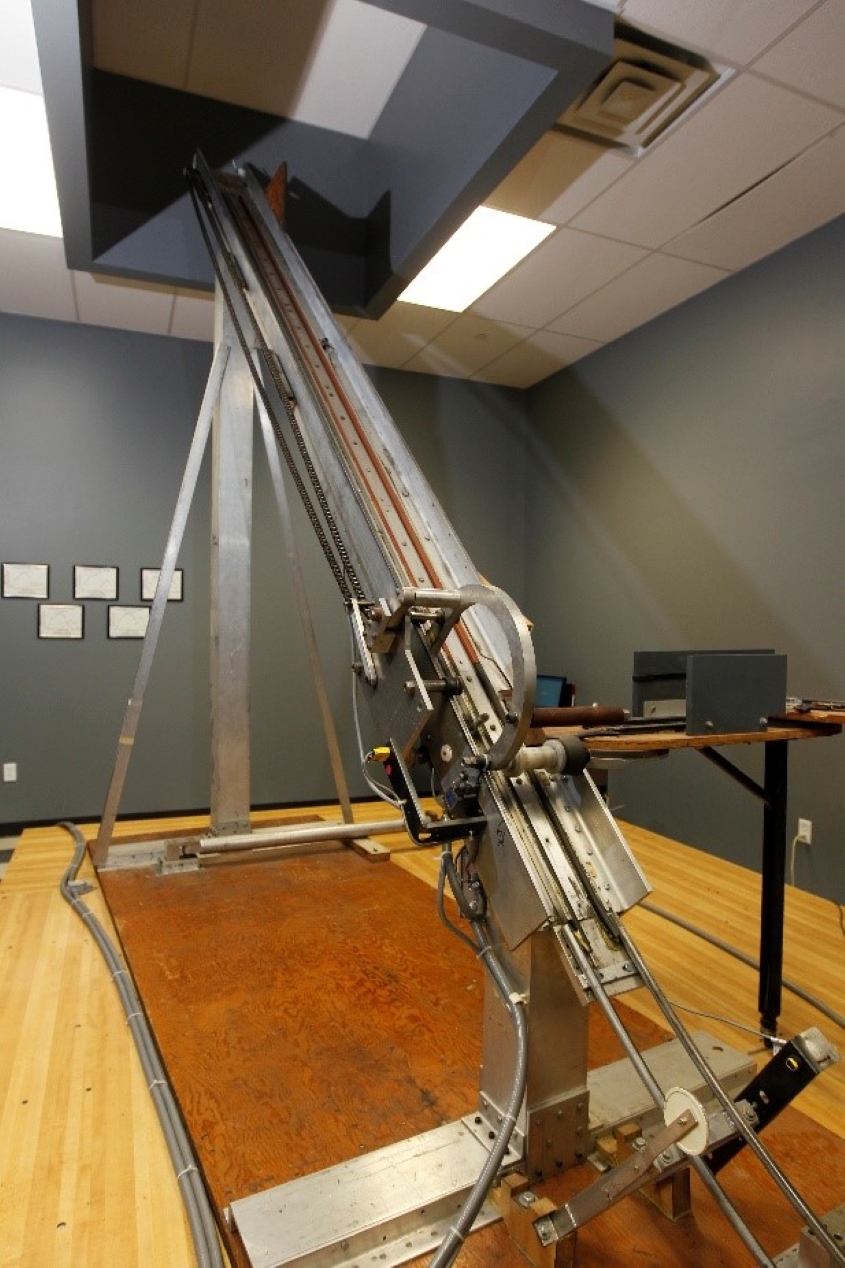
The Equipment Specifications team utilizes its custom USBC-1 Bowlscore machine, an automated ramp to test products for their effects on pin action.
The USBC Bowlscore ramp automatically moves to adjust the entry angle (the angle the ball is traveling at when it enters the pins) and offset (how many inches the balls line of action is offset from the center of the head pin) and collects the pinfall data for each shot. It is designed to replicate an average bowler’s ball speed. For this purpose, we use an average bowler speed of approximately 17 mph and 250 rpm. Then, due to friction, the ball slows to about 14 mph at the pins, and the friction also causes the rotation rate to pick up to about 550 rpm at the pins, which is what the ramp is designed to duplicate.
The USBC Bowlscore ramp can be retrofitted to test different pinsetters, pin decks, flat gutters, or kickback walls to evaluate their impact on pin action.
A full Bowlscore run is designed to analyze pinfall, including strike percentages, across a variety of pocket-entry variables. As a very simple example, an ideal flush-pocket hit will strike at a higher percentage than a light hit. Bowlscore will measure how much this percentage changes as the entry variables change.
A full Bowlscore run consists of rolling the ball through the pin deck across 23 offsets (0.00” to 5.50” in 0.25” increments), 11 angles (zero degrees to 10 degrees in 1-degree increments) and 10 shots each, which totals 2,530 shots per run (23 * 11 * 10 = 2,530).
Small angles normally represent lower-average bowlers. For example, a league bowler in the 180-200 average range may achieve about a 3- 4 degrees entry angle. Elite professionals would have entry angles of 5-7 degrees. Entry angles greater than that are not typical for most bowlers, but some have been measured to achieve up to 10 degrees when trying to maximize entry angle.
Bowlscore data is evaluated using a statistical analysis called the chi-square proportions test to determine if a product changes pinfall from what is expected in a standard environment on free-fall machines.
By using a control set of 12 runs, made up of six different types of pins (40 pins per pin type, 20 pins used in each run), we can develop baseline proportions of how many strikes, nine-counts, eight-counts and counts of seven or less we can expect to see in any one Bowlscore run. Those expected proportions are then evaluated against observed proportions of equipment we test to evaluate any differences.